


The Everyday Memory Survey (EMS) is a set of rating scales designed to assess everyday memory in adults.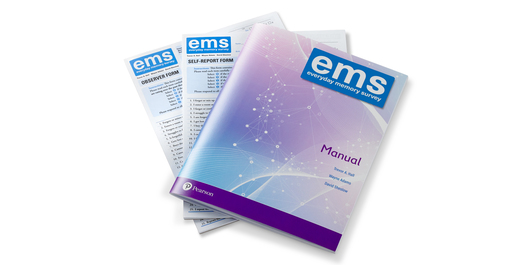
 Activate to view the image in zoom mode
Everyday Memory Survey
EMS
The Everyday Memory Survey (EMS) is a set of rating scales designed to assess everyday memory in adults.Aperçu
Détails du Produit
Webinaires
- Date de publication:
- Fall 2021
- Groupe d’âge:
- 18-90 years
- Niveau de lecture:
- Grade 5
- Temps de passation:
- 10 minutes
- Passation:
- Q-global, Paper-and-pencil
- Formulaires:
- Self-Report Rating Form & Observer Rating Form
- Options de notation:
- Q-global, hand scoring
- Options du rapport:
- Individual, Multi-rater & Progress
- Normes:
- Age-based
Is it "typical" memory decline or something more?
Reduce unnecessary referrals with this quick and easy memory screener
Declining memory function is one of the most common complaints among individuals as they age, and it can be difficult for practitioners and medical professionals to determine whether it's due to cognitive impairment or developmentally normative declines in memory. The Everyday Memory Survey (EMS) allows practitioners and medical professions to screen for individual memory related behaviors in daily life to determine if further testing or a referral is needed.
The Everyday Memory Survey is a set of questionnaires designed to assess everyday memory in adults. Examples of everyday memory include remembering names, keeping track of daily plans, and accurately recalling medication regimens.
Benefits
- The EMS affords clinicians and other care providers a quick, reliable, and valid way to ecologically monitor, manage, and treat patients with known or potential memory impairment.
- The EMS is brief enough to use in many different settings, including primary care clinics, rehabilitation centers, residential care facilities, and private practice.
- The EMS can help eliminate unnecessary referrals for comprehensive memory testing by screening out those with typical memory decline.
Features
- The EMS consists of Self-Report and Observer rating forms. Each form has 25 items and requires approximately 10 minutes to complete.
- The EMS can be administered using a computer or tablet via Q-global, a secure internet-based administration, scoring, and reporting platform available through Pearson. Alternatively, it can be administered in a traditional paper-based format.
View the product flyer
The following training events are available for EMS.
