
KeyMath™ 3 Diagnostic Assessment: Canadian Edition
KeyMath-3 DA
For teachers and specialists who need to assess a full spectrum of essential math concepts and skills, KeyMath-3 DA is an individually administered measure of conceptual mathematics knowledge, computational skills, and problem solving for students in kindergarten through age 21. Including two parallel forms aligned to national math curriculum standards, KeyMath-3 also offers a comprehensive math instruction and intervention program, the KeyMath-3 Essential Resources (ER). The KeyMath-3 is the most current version of KeyMath.KeyMath-3 Diagnostic Assessment Administration, Scoring and Basic Interpretation Live Webinar 6 Hours
A103000197877
Qualification Level
This 6-hour session is designed for individuals who require in-depth understanding on subtest administration and scoring and a basic understanding of profile interpretation. Price includes up to 40 people per session.
Training orders will be processed within 5-7 business days of order placement. A training consultant will contact you to coordinate your training. Training dates are scheduled no earlier than 5 weeks from order placement.
- Publication date:
- 2008
- Age range:
- 5-17:11 years, Grades K-12
- Qualification level:
- B
- Completion time:
- 30 to 90 minutes
- Administration:
- Paper-and-pencil
- Scoring options:
- Manual Scoring
- Other languages:
- French
KeyMath Digital Assets: Now Available!
Digital assets for the Diagnostic Assessment (stimulus books, manual, response booklets for demonstration purposes only) are now available in the Q-global Resource Library.
Digital assets for the Essential Resources Level I and Essential Resources Level II are still in digital development with a current release date later in 2025.
The name KeyMath™ has been synonymous with quality education assessment for almost 2 decades. Like its predecessors, the new KeyMath™ 3 Diagnostic Assessment (DA) is an in-depth measure of essential mathematical concepts and skills. A significant revision of the KeyMath™–R/UCN, it includes various new features:
- Updated and expanded Canadian norms—Data collected 2007/2008, including extended grade norms from grade 10 to grade 12.
- Updated content and new subtest organization— Closely aligned with current math standards, the 10 subtests effectively cover all three math content areas (Basic Concepts, Operations, Applications). The addition of the Algebra subtest makes the assessment more relevant for students at higher grade levels.
- Updated design and graphics—Provides for a more visually appealing, colourful, and stimulating experience.
- Greater flexibility—Allows you to only administer the area and subtests for the content in question, reducing testing time and targeting specific content interventions.
A comprehensive, norm-referenced instrument, the KeyMath 3 DA includes content that covers the full spectrum of math concepts and skills, ranging from early experiences with rote and rational counting through experiences with factoring polynomials and solving linear equations. Two parallel forms (Form A and Form B) allow for test administration in alternating sequence every 3 months. Growth Scale Values (GSVs) enable educators and clinicians to measure progress accurately over time across the full range of math concepts and skills.
10 Subtests Represent Three General Math Content Areas:
1 - Basic Concepts:
- Numeration: Early number awareness; Place value and number sense;Magnitude of numbers; Fractions; Decimals; Percentages; Exponents, integers, multiples, and factors.
- Algebra: Early algebraic awareness; Algebraic uses of numbers and geometry; Symbolic representation; Ratio and proportion; Coordinate graphing.
- Geometry: Early geometric awareness; Two-dimensional shapes; Three-dimensional shapes; Lines and angles; Formulas; Grids and coordinate planes.
- Measurement: Early awareness of measurement; Standard units; Time; Money.
- Data Analysis & Probability: Early awareness of data and probability; Charts, tables, and graphs; Graphical representation; Statistics; Probability.
2 - Operations:
- Mental Computation & Estimation: Early awareness of mental computation; Mental computation chains; Mental computation with whole numbers; Mental computation with rational numbers; Estimation and whole numbers; Estimation and rational numbers.
- Written Computation: Addition & Subtraction: Algorithms to add and subtract whole numbers; Algorithms to add and subtract rational numbers; Integers; Algebra
- Written Computation: Multiplication & Division: Algorithms to multiply and divide whole numbers; Algorithms to multiply and divide rational numbers; Integers; Algebra.
3 - Applications:
- Foundations of Problem Solving: Analysis of problems; Word problems; Problem-solving strategies.
- Applied Problem Solving: Numeration; Algebra; Geometry; Measurement; Data analysis and probability.
The following resources are available for KeyMath-3 DA.
Frequently asked questions follow. Click on a question to see the response.
KeyMath–3 Diagnostic Assessment
The KeyMath–3 Diagnostic Assessment was designed around the National Council of Teachers of Mathematics (NCTM) standards published in the Principles and Standards for School Mathematics in 2000 and the Curriculum Focal Points in 2006. Many, if not most, of these standards are still upheld today and underlie many state standards.
The KeyMath–3 Diagnostic Assessment can be administered as often as every 3 months when alternating between Form A and Form B.
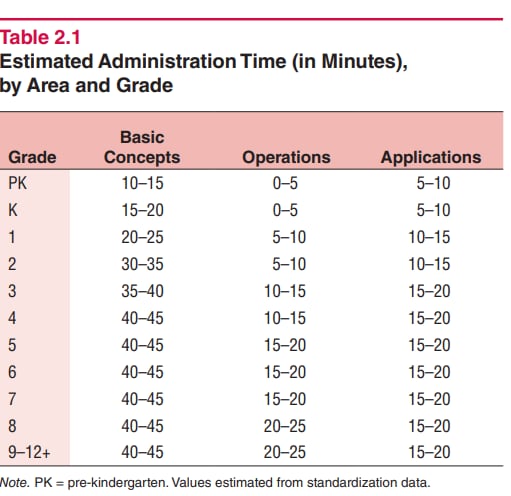
Administration times for the entire battery of subtests range from 30 to 90 minutes, depending on the student's grade level. Practitioners may elect to administer only the subtests that correspond to a particular content area, which will result in a shorter administration time. The table below shows estimated KeyMath–3 administration times, by content area and grade.
KeyMath–3 Essential Resources
The KeyMath–3 Essential Resources materials are designed for maximum flexibility and allow teachers to teach multiple students at one time. The easel presentation of the student activity is designed for use with smaller groups of 1–5 students. When working with 6 or more students, teachers may elect to access the same material in digital format via the Q-global resource library for use with classroom digital displays. Coming in 2025!
Readiness tests are administered prior to the lesson being taught to determine whether the student has the prerequisite skills necessary to learn the applicable concept(s). Posttests are administered after all activities in the lesson have been taught to determine whether the student has grasped the concept(s). In cases where a student did not grasp the required concept(s), the teacher should re-teach the lesson as necessary. Mastery tests are used to determine whether a student has mastered the applicable concept(s).
No, but some program lessons require the use of common classroom objects (e.g., rulers, cubes).
Yes, the KeyMath–3 Diagnostic Assessment provides a direct link to appropriate curriculum activities in the KeyMath–3 Essential Resources, but you can use the program on its own.
The ASSIST is no longer available. At this time, hand scoring must be completed and details about scoring each subtest can be found in the test manual starting on page 17.