Bruininks-Oseretsky Test of Motor Proficiency | Third Edition
BOT-3
The Bruininks-Oseretsky Test of Motor Proficiency™, Third Edition (BOT™-3) is a versatile and comprehensive measure of gross and fine motor skills for children and young adults.- Date de publication:
- Summer 2024
- Groupe d’âge:
- 4:0 – 25:11
- Notation/Interprétation:
- Age-based standard scores, percentile ranks, age equivalents, growth scale values and descriptive categories
- Niveau de qualification:
- B
- Temps de passation:
- Complete Form: 50–90 minutes, Fine Motor Form: 25–45 minutes, Gross Motor Form: 25–45 minutes
- Passation:
- Paper and pencil or Digital via Q-global®
- Formulaires:
- Complete, Fine Motor, Gross Motor, Digital
- Options de notation:
- Q-global or manual scoring
- Options du rapport:
- Comprehensive report
- Normes:
- US
Now with updated norms and improved digital utility!
The BOT-3 measures a broad array of fine and gross motor skills. Eight core subtests and one supplementary subtest allow for in-depth assessment of motor abilities and identification of areas of relative strength.
With the BOT-3, you can:
- Assess the motor development and proficiency of individuals from school age to early adulthood, ranging from those who are typically developing to those with mild to moderate motor challenges
- Support diagnosis of motor impairments
- Inform further evaluation, goal-setting, and interventions
- Develop and evaluate motor training programs
Core subtests
- Fine Motor Precision: includes untimed activities that require precise control of finger and hand movement
- Fine Motor Integration: requires the examinee to reproduce drawings of various geometric shapes of increasing complexity
- Manual Dexterity: uses timed, goal-directed activities that involve reaching, grasping, and bimanual coordination with small objects
- Upper Limb Coordination: consists of activities designed to measure visual tracking with coordinated arm and hand movement, such as catching, dribbling, and throwing a ball
- Bilateral Coordination: contains tasks requiring body control, and sequential and simultaneous coordination of the upper and lower limbs
- Balance: evaluates fundamental balance skills that are integral for maintaining posture when standing or walking
- Strength: measures trunk and upper and lower body strength
- Dynamic Movement: assesses running speed and agility
Supplementary subtest
- Extended Balance: involves more advanced balance skills using a balance beam
Features of the BOT-3
Occupational therapists, physical therapists, developmental adaptive physical education teachers, diagnosticians, and special education professionals appreciate the BOT-3 for its:
- Engaging, game-like tasks
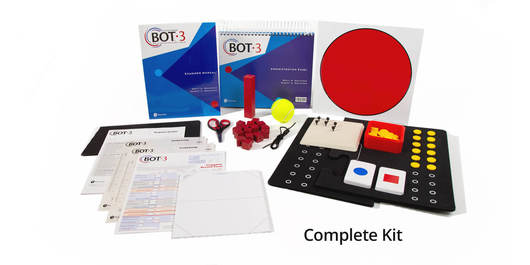
- Large, clear pictures in the administration easel and optional demonstration videos that help examinees better understand the activities you need them to perform
- Supplementary Extended Balance subtest to assess higher-performing individuals (requires Balance Beam not included in kit but available separately)
- Three supplemental scores to provide even more clinically-useful information beyond the subtest and composite scores
- Skilled Manual Performance – a norm-referenced score combining scores from the three subtests focused on skilled use of the hands for fine motor activities – Fine Motor Precision, Fine Motor Integration and Manual Dexterity – to provide a ‘pure’ measure of fine motor performance
- Movement Fundamentals Score – a criterion-referenced score comprising select items from across four BOT-3 subtests (Upper Limb Coordination, Bilateral Coordination, Balance, Dynamic Movement). Measures Fundamental Movement Skills considered to be the building blocks of skilled movement required for participation in sports, leisure and activities of daily living
- Motor Planning and Coordination – a norm-referenced score encompassing items from the full BOT-3 test that were shown to have particularly high discrimination between the Developmental Coordination Disorder (DCD) and typically developing groups
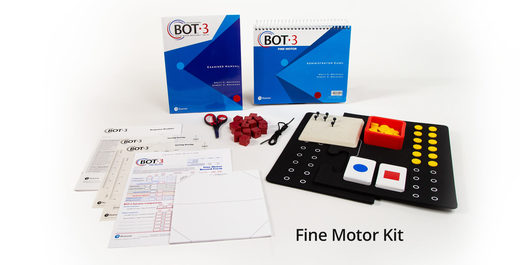
- Separate fine motor and gross motor kits available
- The fine motor kit includes subtests for: Fine Motor Precision, Fine Motor Integration, Manual Dexterity, and Upper-Limb Coordination
- The gross motor kit includes subtests for: Bilateral Coordination, Balance, Extended Balance, Dynamic Movement, and Strength (Balance Beam required for Extended Balance)
The following resources are available for BOT-3.
Sample Reports
Flyers
Videos
- BOT-3: Comprehensive motor assessment is within your grasp
- BOT-3: An Overview of On-Screen Administration
- BOT-3 Unboxing
- Overview Video
Blogs
BOT-3 Frequently Asked Questions
Click on a question to read the response.
The BOT-3 Balance subtest does not require a balance beam, so to reduce the cost and weight of the kit, the beam was not included. However, it can be purchased separately by examiners wishing to administer the Extended Balance items. Examiners who own a BOT-2 kit will not need to purchase an additional beam as the same beam is used in BOT-2 and BOT-3.
No. The BOT-3 Brief is available separately and provides a brief overview of motor skills. It can be used for screening or combined with other standardized measures.
Yes. The BOT-3 Brief kit is available either separately or as part of the BOT-3 Complete/BOT-3 Brief Combo Kit.
There is no "upgrade kit" available. While some of the manipulatives are the same in both kits, others have been altered for BOT-3 to improve their utility. The BOT-3 and BOT-3 Brief also have new manuals, administration easels, record forms, and response materials, so the majority of the items in the kit are new and cannot be repurposed from the old edition. However, if you have a BOT-2 balance beam, you can use this to administer the Extended Balance items.
Yes. There is both complimentary and paid training available for the BOT-3. Register for complimentary introductory training here or via the Overview Video link on the Resources tab.
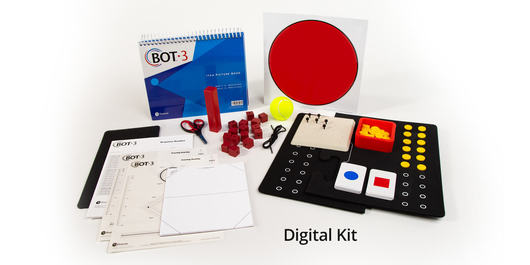
The digital kit is cheaper because it doesn't include an administration easel. The administration easel is not required when administering the BOT-3 using a digital record form as all of the information contained in the easel is included within the digital record form.
The Growth Scale Values (GSVs) are new for BOT-3, although they are not unique to this test. They provide a score metric that does not involve age-based comparisons. A GSV reflects the range of ability on a scale from very low to very high. An examinee’s test performance can be placed on this scale to track improvement in ability. GSVs can be used to quantify change in performance on a given subtest over multiple administrations of the BOT-3. The advantage of using GSVs rather than normative scores for this purpose is that the GSV provides a quantifiable measure of an examinee’s changes in ability, even if the amount of change is not sufficient to narrow the gap between the examinee's performance and that of their same-age peers. GSVs are a particularly useful supplement to traditional norm-referenced scaled and standard scores for examinees who demonstrate more pronounced motor challenges. For example, an examinee whose motor development is occurring at a slower rate than typically developing peers may not show improvement in their norm-referenced scaled score for a particular subtest from one administration to the next, but their GSV may increase, indicating that their underlying ability on the tasks in this subtest has improved. The reproducible form in Appendix F of the BOT-3 Manual can be used to track GSVs and determine significant change over multiple administrations of the BOT-3.
Further Information on GSVs can be found in Chapters 2, 3, and 5 of the BOT-3 Examiner Manual.
For Q-global users, the demonstration videos are embedded in the digital record form. Links to the videos are also available in a pdf document in the Q-global resource library. Test users who don't have access to Q-global may view the BOT-3 Demonstration Videos Reference Sheet.
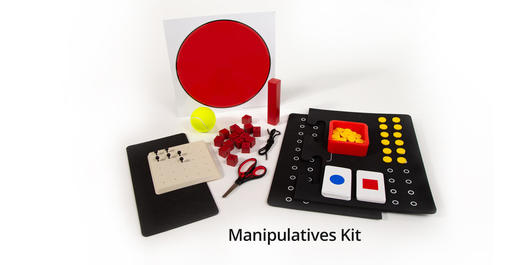
Some manipulatives in the BOT-3 are the same as those used in the BOT-2. The labelling will be updated as inventory depletes, but in the interim, some manipulatives labelled as BOT-2 may be included in BOT-3 kits - this is not an error and you can use the items when administering the BOT-3.
It is important that the token pad is flat to ensure standardized administration of the test items that require it. If your token pad does not sit flat on the table, you can try bending it back the other way or placing a heavy object on it to flatten it out (ensure that the object is removed prior to using the token pad for test administration). You can also tape it down if needed. Tape should be placed at the top and bottom of the pad rather than the sides, to avoid breaking the join in the centre where the pieces fit together. Ensure that you don't subject your token pad to extremes of temperature (for example a hot vehicle) to avoid warping. The BOT-2 token pad cannot be used as a substitute as it is a different size and color and doing so would affect standardization.
The reproducible Extended Balance form is found in the BOT-3 manual on page 174 (Appendix E) and can be photocopied as needed. Chapter 6 of the manual explains how to use and record the Extended Balance items and scores.
The following training events are available for BOT-3.

Get it with the Digital Assessment Library!
K-12 districts get unlimited access to a library of over 40 digital assessments for a simple, annual price based on student enrollment
Learn more about DALRelated Items