Behavior Assessment System for Children | Third Edition
BASC-3
A comprehensive set of rating scales and forms, BASC-3 helps you understand the behaviors and emotions of children and adolescents. Guidance on using this test in your telepractice.BASC-4 is now available!BASC-3 Live Question and Answer Virtual 1 Hour
A103000072174
Qualification Level
Price includes up to 40 people per session. This 1-hour Q&A session supports participants who have attended a previous session or are familiar with the assessment. A Pearson expert will meet with participants to address follow-up questions and support specific assessment-related needs. To use the hour efficiently, participants may submit questions in advance. Q&A sessions do not include handouts or slides.
Training orders will be processed within 5-7 business days of order placement. A training consultant will contact you to coordinate your training. Training dates are scheduled no earlier than 5 weeks from order placement.
- Publication date:
- 2015
- Age range:
- 2:0 - 21:11 (TRS and PRS); 6:0 through college age (SRP)
- Scores/Interpretation:
- T scores and percentiles, for a general population and clinical populations
- Qualification level:
- B
- Completion time:
- 10-20 minutes (TRS and PRS), 30 minutes (SRP)
- Scoring options:
-
Q-global™ Web-based Administration, Scoring, and/or Reporting, or Manual Scoring
- Other languages:
- French
- Telepractice:
- Guidance on using this test in your telepractice
BASC-4 Training
BASC-3 uses a comprehensive set of rating scales and forms to provide a complete picture of a child's or adolescent’s behavior and emotions.
Benefits
- Differentiate between hyperactivity and attention problems
- Identify behavior problems as required by IDEA, and for developing FBAs, BIPs, and IEPs.
- Strong base of theory and research gives a thorough set of highly interpretable scales.
- Access to efficient and extensive reports using computer scoring and interpretation.
Features
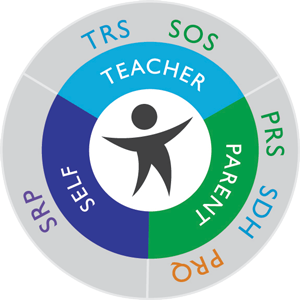
BASC-3 applies a triangulation method for gathering information. It analyzes a child’s behavior from three perspectives: self, teacher, and parent.
- Teacher Rating Scales (TRS) measure adaptive and problem behaviors in the preschool or school setting.
- Parent Rating Scales (PRS) measure both adaptive and problem behaviors in the community and home setting.
- Parenting Relationship Questionnaire (PRQ).
- Self-Report of Personality (SRP) provides insight into a child’s or adult’s thoughts and feelings.
- Student Observation System (SOS) enables clinicians and other qualified observers to code and record direct observations of a child’ behavior in a classroom setting.
- Structured Developmental History (SDH) offers a comprehensive history and background survey that supplies a thorough review of social, psychological, developmental, educational, and medical information on the child.
Scales
Teacher Rating Scales (TRS)
- Completed by: Teacher or other qualified professional
- Measures: Adaptive and problem behaviors in the preschool or school setting
- Forms: Preschool (ages 2 to 5), child (ages 6 to 11), and adolescent (ages 12 to 21)
- Administration Time: 10-20 minutes
- Number of items: 105-165, using behaviors that are rated on a four-point scale of frequency, ranging from "Never" to "Almost Always"
- Validity: Validity and response set indexes used to help judge the quality of completed forms are also available.
Parent Rating Scales (PRS)
- Completed by: Parent or caregiver
- Measures: Adaptive and problem behaviors in the community and home setting
- Forms: Preschool (ages 2 to 5), child (ages 6 to 11), and adolescent (ages 12 to 21)
- Administration Time: 10-20 minutes
- Number of items: 139-175 items, using a four-choice response format
- Validity: Validity and response set indexes used to help judge the quality of completed forms are also available.
Self-Report of Personality (SRP)
- Completed by: Self
- Measures: Insight into a child's or adult's thoughts and feelings
- Forms: SRP-I (ages 6 to 7), child (ages 8 to 11), adolescent (ages 12 to 21), college (ages 18 to 25), Spanish version available for the child and adolescent forms only
- Administration Time: 30 minutes
- Validity: Includes validity scales for helping judge the quality of completed forms.
- A Spanish version is available for the child and adolescent forms only.
BASC-3 Student Observation System (SOS)
- Completed by: Teacher or other qualified professional
- Records: Direct observations of a child’s behavior in a classroom setting
- Assesses: Both adaptive and maladaptive behaviors, from positive peer interaction to repetitive motor movements
- Administration Time: Uses momentary time sampling during three-second intervals spaced 30 seconds apart over a 15-minute period
- Can be employed for the direct observation portion of a Functional Behavior Assessment and can be used singly or with other BASC-3 components.
Structured Developmental History (SDH)
Offers a comprehensive history and background survey that supplies a thorough review of social, psychological, developmental, educational, and medical information on the child.
Emotional Disturbance Qualification scales (EDQs)
Aligning with IDEA Criteria for ED, BASC-3 EDQs reflect new combinations of existing BASC-3 clinical and adaptive scales. The EDQs cover five of the six IDEA criterion for ED, including:
- Unsatisfactory interpersonal relationships
- Inappropriate behavior and/or feelings
- Unhappiness or depression
- Physical symptoms or fears
- Schizophrenia and related disorders of thought
Resources
The following samples and summaries are available for BASC-3.
Sample Reports
Summary Documents
- BASC-3 Scales, Composites and Indexes for the TRS, PRS and SRP
- BASC-3 Brochure
- BASC-3 Publication Summary
Video
Tip Sheets for Parents
The following training events are available for BASC-3.

Get it with the Digital Assessment Library!
K-12 districts get unlimited access to a library of over 40 digital assessments for a simple, annual price based on student enrollment
Learn more about DALRelated Items