Wechsler Individual Achievement Test, Fourth Edition-Canadian
WIAT-4-CDN
The WIAT®-4–CDN, the most current version of the WIAT, is ideal for clinical, educational, or research teams who need to measure comprehensive listening, speaking, reading, writing, and math skills. This assessment includes new Phonemic Proficiency subtests and automated scoring with Essay Composition. See our Guidance on using this assessment remotely.- Publication date:
- 2024
- Age range:
- Individuals 4:0–50:11
- Scores/Interpretation:
- Fall, winter, and spring grade-based standard scores, age-based standard scores, percentile ranks, stanines, NCEs, age and grade equivalents, and growth scale values (GSVs).
- Qualification level:
- B
- Completion time:
- Varies by grade level and number of subtests administered
- Administration:
- Paper-and-pencil, Q-interactive®, and Q-global® (using digital stimulus materials)
- Scoring options:
- Q-interactive® Administration and Scoring, Q-global® Scoring & Reporting or Manual Scoring
- Report options:
- Reports include Score Summary, Subtest Comparisons, Achievement/Ability Comparisons; Parent Report
- Uses:
- Analyses of academic achievement; supporting diagnoses of specific learning disabilities; Academic program placement; Intervention planning; Dyslexia screening/evaluation
- Telepractice:
- Guidance on using this test in telepractice
Wechsler Individual Achievement Test®, Fourth Canadian Edition (WIAT®-4-CDN) expands upon the flexibility of this widely used achievement test. Suitable for use in a multitude of settings and available to a wide array of professionals, the newest edition of the WIAT has some exciting updates to help you identify what support they need to achieve more.
New subtests and more flexible scoring
WIAT-4 -CDN features new subtests and expanded scoring capabilities, including composites for Phonological Processing, Orthographic Processing, and Writing Fluency.
The Dyslexia Index Score supports efficient, reliable screening.
- New: Phonemic Proficiency: measures speed and accuracy of phonological manipulation
- New: Orthographic Fluency: measures speed of irregular word reading
- New: Decoding Fluency: measures speed of pseudoword reading
- New: Sentence Writing Fluency: measures speed of sentence composition
Three different kit options to support your needs
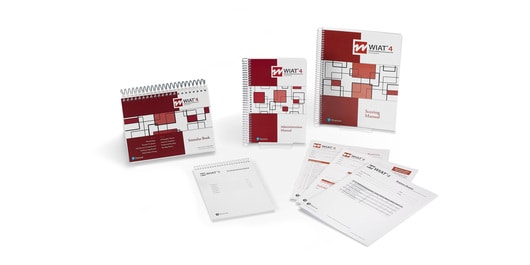
- Print Plus Digital Kit – This kit is primarily a physical kit, but includes required Q-global digital assets such as the Technical Manual with Norms, Audio Files, and other handscoring forms that are printable.
- Print Plus Digital Kit with Q-global Scoring – This kit is the above kit with a year of unlimited Q-global scoring included.
- Digital-only Kit with Q-global Scoring – This kit includes all digital components, including stimulus books, all manuals, audio files, and additional digital handscoring forms for use with in-person digital administrations or remote administration via telepractice. Note: Printed record forms and response booklets are required as an additional purchase.
Resources
The following resources are available for WIAT-4-CDN.
WIAT-4 CDN on Q-interactive at a glance
Available with
- Max and Light
Subtest pricing
Scoring and reporting
- Score Report
- Excel Report
Benefits of WIAT-4 on Q-interactive
- Enjoy automated scoring of the Essay Composition subtest.
- Enhance your WIAT-4-CDN results by co-administering other achievement measures, such as the KTEA-3 Rapid Automatic Naming subtest.
- Easily build an ability-achievement battery by combining subtests from WIAT-4-CDN with ability measures, such as the WISC-V CDN, and only pay for the subtests you use.
- Efficiently manage your WIAT-4 materials so you can focus on the examinee.
How Can I Buy WIAT-4 on Q-interactive?
New customers:
Annual Q-interactive licenses can be purchased online or by calling Customer Support at 866-335-8418. See the Q-interactive ordering tab for more information on license options.
Current Q-interactive customers:
If you want to add the WIAT-4-CDN to your account, visit our online order form or call Customer Support at 866-335-8418.
School customers
Want unlimited use of WIAT-4 CDN (and other assessments) on Q-interactive? Contact your assessment consultant to learn more about Digital Assessment Library (DAL).
Select a question below to see the response.
General
The Canadian Supplement to the WIAT–4 Administration Manual is an appendix that allows for the administration of WIAT–4 content that has been adapted for the Canadian population. The four subtests with administration changes include:
- Listening Comprehension – Oral Discourse Comprehension
- Reading Comprehension
- Math Problem Solving
- Oral Reading Fluency
These Canadian Supplement subtests should replace the subtests contained within the main chapters of the Administration Manual. The order of administration of subtests has not changed—the subtests should be administered as they are presented in the Record Form. A red and white Canadian maple leaf is located next to each of these four subtests in the Record Form to remind users to switch to the Canadianized subtest in the Supplement. For ease of use, each of these four subtests have the administration instructions reproduced in their entirety within the Canadian Supplement.
Outside of the Canadian Supplement, all content in the Administration Manual uses US English terminology and spelling (e.g., PK for JK, favorite for favourite). However, none of these differences involve examinee-facing stimuli.
Note that two subtests have changes that do not impact the Administration Manual and therefore are not in the Canadian Supplement: Numerical Operations Response Booklet and Record Form, and the Orthographic Fluency Stimulus Book.
Data collection for the WIAT-4 Canadian was completed via paper-based administration, and the WIAT-4 Orthographic Choice subtest is a digital-only subtest. Therefore, the WIAT-4 Canadian did not collect data on this subtest and it is not part of the Canadian version.
Examiners who wish to use the WIAT-4 Orthographic Choice subtest on Q-interactive must contact Pearson to have the US WIAT-4 added to their license. The US-normed Orthographic Choice subtest can be administered on Q-interactive in a separate battery and cannot be combined with WIAT-4 Canadian subtests.
The Progress Monitoring Assistant can only be used to compare WIAT-4 administrations. There were no studies done on WIAT-III to WIAT-4 comparisons.
Digital assets are available for remote administration of the WIAT-4 Canadian. WIAT-4 telepractice guidance documents are provided here.
Guidance for score interpretation following a period of educational disruption is included in the WIAT-4 Technical & Interpretive manual, and on the Pearson telepractice website under Resources.
Yes, these data will publish with the upcoming WAIS-5 Canadian. At the time of the WIAT-4 Canadian development, WAIS-5 Canadian was also in development, so the decision was made to complete the validity study using both new versions. More information about this validity study will be available as the WAIS-5 Canadian development and release unfolds.
If you have the WIAT-III Canadian edition on your “light” or “max” license as an existing user, you will automatically gain access to the WIAT-4 Canadian edition upon release. You do not need to do anything for this digital version. However, you will need to preorder WIAT-4 Canadian Response Booklets (A103000393427) to complete what is needed for administration.
The US Scoring Manual includes in-depth scoring instructions for many of the WIAT-4 subtests that will apply to the WIAT-4 CDN subtests as well. The Canadian-specific components relevant to development and norms are reflected in the Technical and Interpretive Manual.
Yes, the WIAT-4 Canadian Response Booklet is substantially different from the WIAT-4 US response booklet. Practitioners will need to purchase WIAT-4 Canadian Response Booklets Qty 25 (Print) A103000393427 for use with the WIAT-4 Canadian.
Standard scores are no longer provided for Oral Reading Accuracy and Oral Reading Rate due to the highly skewed distribution of raw scores; instead, base rate information is provided for accuracy (number of errors) and rate (elapsed time) by item set. A base rate, or cumulative percentage, conveys information about how a raw score is ranked (from 0 to 100) in comparison with the scores obtained by examinees who took the same item set. You can read more about this and Base Rates on pg. 59 of the WIAT-4 Canadian Technical and Interpretive Manual.
For writing and spelling subtests, examiners can ask students to clarify illegible handwriting after the test is completed. If the handwriting remains unrecognizable despite the student's explanation, this qualitative information is noted, but the oral response isn’t scored. If the student’s explanation makes the writing recognizable, it may be considered based on the subtest's scoring rules. For Essay Composition, the writing must be legible enough for the examiner to transcribe and score it. If most of the writing is illegible and oral clarification doesn’t help, the essay cannot be scored.
WIAT-4 scoring rules do NOT require correct letter order to receive credit, but order may provide context clues when a letter is ambiguous or could be a reversal.
The WIAT-4 Administration manual states that the examiner may clarify to the examinee, "...write the letters of the alphabet in order, starting with a-b-c, or you can write any letters you know, like the letters in your name." This is to help the examinee understand the task and give the best performance possible.
The WIAT-4 Scoring manual states, "Order of letters should be used when determining whether or not a letter receives credit, including alphabetical order or spelling of words." This guidance is part of the section on using context clues to score the task, but does NOT mean that the letters must be in alphabetical order to receive credit. Letter order is a strategy that should be used to help determine which letter a student wrote, if needed. If the student did not use alphabetical order, then letters would still receive credit if they were legible.
Audio Files
The audio files are complete; however, some multimedia applications trim slightly into a track to allow smooth transitions. We recommend using Quicktime, iTunes/Apple Music, or Windows Media Player for the cleanest, most reliable playback of the WIAT-4 audio files.
By default, the WIAT-4 audio files are organized into folders by subtest
Within the Oral Discourse Comprehension folder:
- Files are organized in standard administration order when sorted alphabetically
- Files that may be used for more than one item will be named accordingly (e.g., Item 08_09)
Within the Phonemic Proficiency folder:
- Files are organized into subfolders, by section, to align with Phonemic Proficiency discontinuation rules
- Files for the demonstration items appear first in each section's subfolder and are followed by the remaining items for that section listed in administration order
The audio files required for administration are attached to a downloadable PDF located within the Resource Library of Q-global. These must be accessed or downloaded using a free third-party PDF viewer such as Acrobat Reader®. With the PDF file open, open the attachments panel, and save the audio files to your computer for use during administration. We recommend using Quicktime, iTunes/Apple Music, or Windows Media Player for the cleanest, most reliable playback of the WIAT-4 audio files. Note: Using a web browser to access attached audio files is NOT recommended because not all browsers support the functionality necessary to access the attachments panel.
Essay Composition
Essay Composition can be administered at Grade 3, but this subtest is not included in the Written Expression composite until Grade 4.
The examiner is not permitted to read the target words for the examinee. However, examinees are permitted to skip an item, if needed, as indicated in the administration instructions.
Option 1
The Essay Composition subtest can be scored automatically via Q-global or Q-interactive. Automated scoring is more consistent but just as reliable as hand scoring. Human scores and automated scores share a strong correlation.
Option 2
For paper and pencil customers without access to Q-global or Q-interactive, Essay Composition can be hand scored using the (correct minus incorrect word sequences) scoring rules provided in the manual.
To use automated scoring, you will need internet access and a Q-global or Q-interactive account that includes WIAT-4. The following steps are followed to utilize automated scoring of Essay Composition:
- Step 1: The examinee hand writes the essay in the Response Booklet;
- Step 2: Within Q-global or Q-interactive, the examiner transcribes the essay by typing the essay exactly as it was written into the essay entry field;
- Step 3: The essay is submitted and scored by Pearson's Intelligent Essay Assessor™ (IEA). Results are returned in seconds.
The Scoring Manual explains that letter reversals are penalized as part of spelling. However, remember that letter reversals are not part of the autoscoring process because they cannot be transcribed.
Illegible words should be clarified following the guidelines provided in the manual.
Typing is a skill that not all examinees have acquired. Under timed conditions, examinees who type well can write more and score higher than examinees who cannot type well. In addition, many students, especially in the early grades, hand write essays in school, so this method has ecological validity.
The WIAT-4 scoring rules are based on the (unchanged) Grammar & Mechanics score from the WIAT-III, which correlates strongly with overall writing quality and has high clinical sensitivity. The WIAT-III scores for Word Count and Content & Organization are not included in the WIAT-4; instead, a Content and Organization Qualitative Analysis is provided to assess these areas.
A patented technology based on over twenty years of research and development, IEA has been proven to score written essays as accurately as trained human scorers. IEA scores essays based on the traits included in the hand scoring rubric.
The IEA scoring engine assesses the grammar/syntax and the mechanics of the transcribed essay. When an examiner submits an essay for scoring, the IEA assesses features of the essay and compares the essay to a training set - a large database of training essays previously scored by human scorers. The IEA assigns a score based in part on the similarity of the essay to the training set.
Examiners should not attempt to score essays that are written in a language other than English, incomprehensible essays (e.g., essays with a high number of severely misspelled words), or essays that are completely off topic (i.e., the examinee did not follow the instructions). Essays must have a minimum word count of 30 to be scored; however, at least 40 words is recommended.
The following training events are available for WIAT-4.

Get it with the Digital Assessment Library!
K-12 districts get unlimited access to a library of over 40 digital assessments for a simple, annual price based on student enrollment
Learn more about DALRelated Items